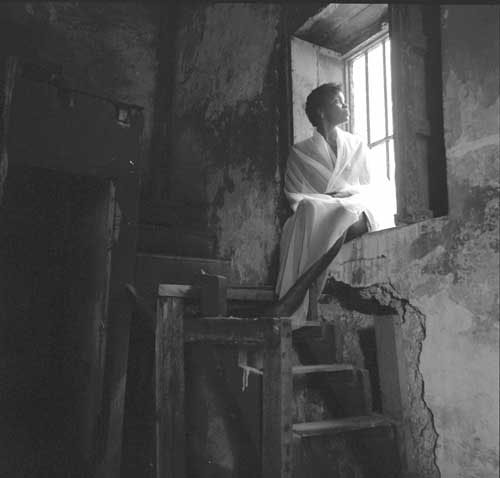
 This photo was made in an old building in Havana Vieja. I liked the old run down buildings, the bright light, and the windows and doors that streamed the light through. A series of these photos is on my web site, www.riowatauga-art.com
Monday, September 11, 2006
La Luz
This photo was made in an old building in Havana Vieja. I liked the old run down buildings, the bright light, and the windows and doors that streamed the light through. A series of these photos is on my web site, www.riowatauga-art.com


Wednesday, August 23, 2006
Babalao with Chicken
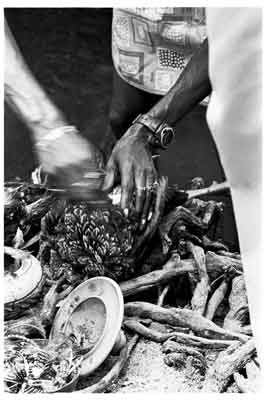 Ernesto, the Babalao at the ceremony, is sacrificing the chicken. There was an array of bowls, fruits, nuts, and bottles of rum set up. Some of these items then had chicken blood sprinkled over them. After this people danced, sang, and the drums beat louder and louder until one or two dancers fell into trances and dropped to the ground-I think from both emotional, spiritual, and physical exhaustion. It was hot, humid, and they had danced non-stop for more than an hour. When we went to the beach and Maria danced in the edge of the ocean she eventually collapsed and was simply floundering in the surf. My old life guard instincts kicked in and I bounded into the surf as if I was once again 19 and back at the beach in South Carolina. It was an easy rescue.
Sunday, August 13, 2006
Sacrifice
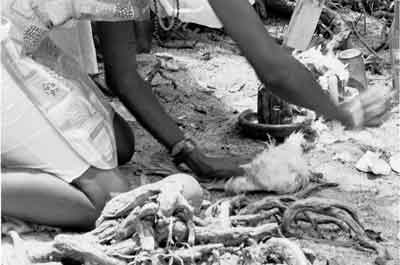 Most of the Santeria ceremonies involve a sacrifice, typically a chicken. Here Maria, the person for whom the ceremony was being held, handles the sacrificed chicken. She suffers from Hepatitis C infection, had been losing weight and had visited a babalao who had recommended the sacrifice and ceremony as a means of asking a spirit for help in attaining better health.
Friday, August 04, 2006
 This woman is dancing in time to the chanting of Antonio and the beat of several drums-a bongo and a conga drum that were brought for the ceremony. The rhythm is infectious. Two of the dancers became transfixed by the music and the dancing and went into trances. Maria, one of the two, fell in the surf. My old lifeguard instincts were still present I suppose for I crashed into the surf to the rescue. It was a fascinating experience.
Monday, July 24, 2006
Antonio y Ellagua
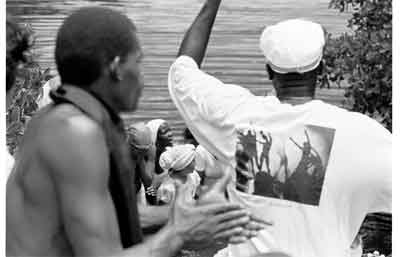 One afternoon Roberto and I were talking. He asked me if I wanted to go to a Santeria ceremony the next day. I asked if the students could go and he said "OK." WE commandeered a van the next morning and drove out toward Cojimar and turned off the road toward the beach. We ended up at a small beach with a Rapido and nothing else. The key thing at the beach was that a freshwater river entered the ocean there. The Babalao had told Roberto and Maria that this was the type of place they should find for the ceremony. Antonio, who has been pictured before, is shown here wearing his tee shirt I had given him a year or two before. It was for an exhibition and the photo on the shirt was made at the Tropicana. Antonio sang, chanted, drank rum and puffed his cigar for several hours non-stop during the ceremony. I don't know how much of this was real, how much for show, but it was a fascinating event.
Friday, July 21, 2006
Hanging Out
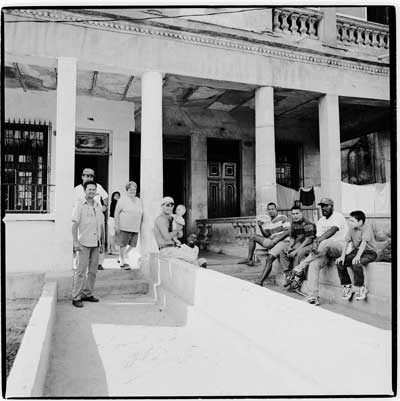 It is a hot Saturday afternoon. All these folks are out in their front yard which sits on Linea. They are joking, drinking rum, and having a good time. All of them live in apartments in the house behind them. The old homes in Vedado and some in Miramar have been divided up into apartments. Note how one apartment has been repainted and another has not. Almost all the old homes not taken over by businesses or rented to embassies and their officials have been sub-divided like this. Some are reasonably well maintained. Others are not. I guess that it is a lot like public housing in most parts of the world.
Tuesday, July 18, 2006
Three clerks
 These guys who are enjoying their morning cigars were all working in a small shop. There was not much merchandise for sale and one person certainly could have done the job. There are a lot of situations like this throughout Cuba. There is definitely no thought given to efficiency. Labor is cheap, and an effort is made to have everybody "employed." A friend of mine once told me that when he was working in Havana as a press photographer there were two people in the elevator of his hotel at all times. One person asked "What floor?" Then, the other person pressed the button.
Sunday, July 16, 2006
Private Food Stand
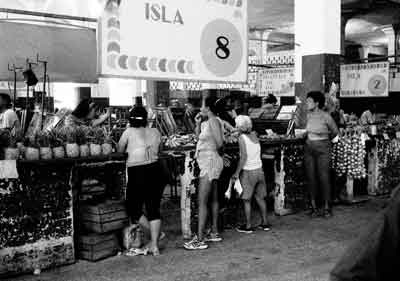 This food stand has better offerings than the state owned one. Here the producers sell their products and then they are taxed. Their products are better although far from outstanding. Most of the choice produce goes to the hotels and restaurants that cater to the tourist industry. Also some is exported, most of the pineapple, for instance, goes to Switzerland I have been told. At the house where we generally stay, the owner goes out in the morning and returns later with several bags of good vegetables and fruits. I don't know where he gets it, I don't ask, I just realize that the bolsa negra is alive and well.
Saturday, July 15, 2006
State Owned Produce Stand
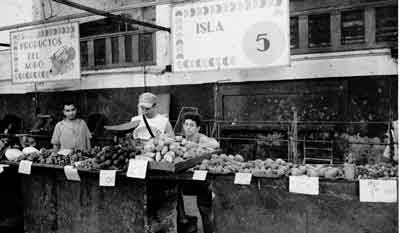
In this stand at the produce section of the market are the vendors for the state. The produce comes from state owned and run farms. Hardly anyone shops there. The produce is smaller, more discolored, and is not as fresh as that sold in other stands. As a consequence there are rarely customers shopping. The vendors all seem quite bored and resigned to their situation.
Thursday, July 13, 2006
More Market
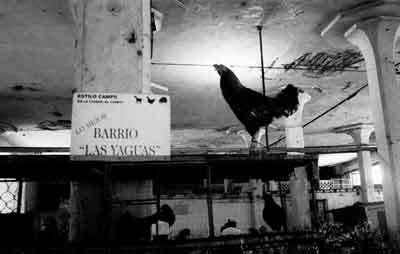 Upstairs at the market is the meat department. There are slabs of beef, pork, and various butchered cuts of meat sold here. Nothing is refrigerated. In the back of the meat market is the live section which has chickens, guineas, and other fowl for sale. This is a place where life and death, existence and non-existence, and to some extent the balance among living things comes to its cross roads. There are not many vegetarians in Cuba in my experience, but there is not much to please the palate of a serious meat eater. I find it fairly easy to eat a lot of vegetable-fruit meals, leaving the meat and seafood to others. Needless to say, there is not a pandemic of obesity-childhood or otherwise in Cuba.
Tuesday, July 11, 2006
Free Market
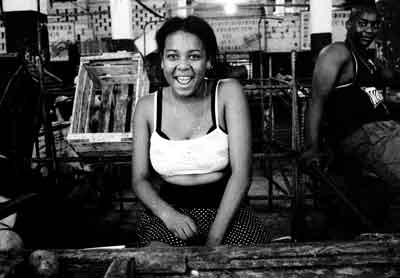 One of my favorite things to do while in Havana is to go the Free Market over in Cerro. It is at a big crossroads, full of food vendors and lots of activity. Around the outside are several shops that sell the relics and implements needed for various santeria rites. One sees people there with live chickens and it is assumed that they are headed for sacrifice. Inside the majority of people are happy and are having a good time. I think this girl has a great smile. Prices are ridiculously low until you realize that you as an Anglo are being charged in dollars and the Cubans are paying in pesos, this is a convenient conversion method, but it is hardly correct. I don't complain though, it is not a lot, the fruit is fresh and tasty, and the money helps the people to survive a few more days. One can spend an afternoon there without problem and if you like to make photos of people, then you can spend several days.
Saturday, July 08, 2006
Sitting on La Rampa
 Calle 23 is a busy street, it is main street in Vedado. It stretches up from the Malecon past the Habana Libre Hotel heading up in the general direction of the University. It has shops, markets, a couple of dance clubs and a great jazz club along the way. All of the airlines have their offices there and there are several travel agents. My friend Roberto goes by the cell phone office to buy some more time on his phone each time he has spare money. There is always a crowd of people. Many just hang out. Hanging out is a very popular pastime in Havana. In most cities I see people walking from one place to another. Those who are sitting on benches or just standing around are usually identifiable as tourists or retirees. It is different in Havana. Young men will stop you and ask you where you are from. A typical American might question this intrusion or fear they were being hustled. Sometimes you are, especially when the next question is "You want cigars?" At other times you discover the person is just interested, wants to make conversation, ask you something about the US, or tell you about their father who lives in Hialeah or Fort Lauderdale. You realize just how sheltered or out of touch many Cubans are when a bright seeming young man asks you " Where is the weather best, Miami or Detroit?"
Tuesday, July 04, 2006
America in Cuba
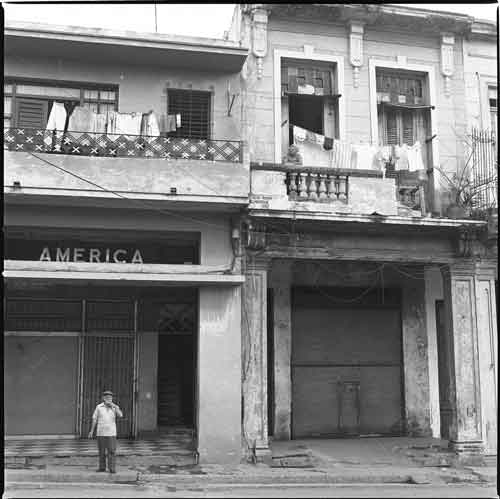 All about one sees the remnants of the American presence in Cuba. Most of the Cuban people express their strong fondness for Americans. In spite of the official differences between the governments at a street level the people can get along just fine. I think most people would like to see both countries live up to the ideals of the Fourth of July and its representation of freedom. More and more those freedoms are being lost and this trend must stop. Those who treasure freedom must stand up not only against intruders or terrorists, but against over reaching by insulated, out of touch governments. This premise is applicable to both the USA and Cuba.
Saturday, July 01, 2006
Plaza in Cienfuegoes
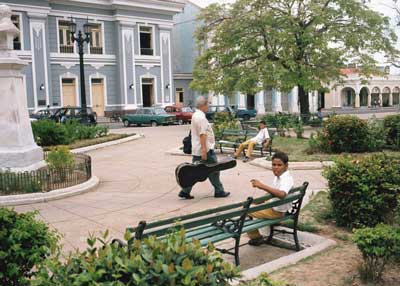 Another picture of Cienfuegoes. The plaza is full of school kids most afternoons. This man is on his way to work as a musician. All of the buildings surrounding the plaza are fairly well kept and painted mainly soft pastel, tropical colors. It was a bit difficult to find much in the way of good food in Cienfuegoes. There are a few places frequented by the tour buses, but the smaller restaurants and cafes left a lot to be desired.
Thursday, June 29, 2006
Local Transportation
 These horse and wagon outfits are very common in many of the towns of Cuba. Here in Ceinfuegoes one finds this arrangement all over the place. People hop on and off, socialize, and all seem perfectly content with the horse drawn wagon as their means of getting about. Needless to say, the gas production exceeds the gas consumption. These vehicles pretty much run on straw and grain. I realize that this is archaic to most of us worldy moderns, but it works and meets the needs of the system. When people don't have big or important jobs, rushing about is much less "important."
Sunday, June 25, 2006
CDR in Cienfuegoes
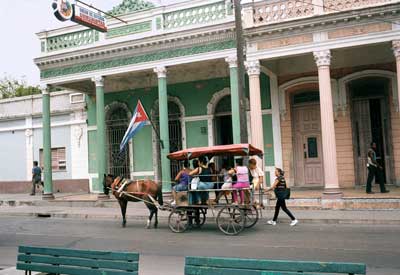 Cienfuegoes is such a beautiful place it requires color film. Even if like me, you are a total amateur in color, you know you have to do it. The pastels of the buildings are gorgeous. The quaintness of the horse drawn carriages which provide the main form of public transportation add to the charm. They each have a kerosene lantern hanging beneath them so that they can be seen at night. Very much a tourist destination the main drawback are the beggars and scammers. It seems everyone in Cienfuegoes has an angle or a deal for you. I have had business deals proposed by university professors, standard propositions for food, lodging, girls, boys, and cigars. At least when you say "No" most of them leave you alone after that, but it does make it less pleasant. This is hardly a Cuban thing, it occurs throughout out the world, especially the third world and the emerging nations. I have experienced it in Mexico, Puerto Rico, Morocco, and surprisingly in Budapdest. No doubt were I more widely traveled, I would have experienced it elsewhere. None the less, Cienfuegoes is a beautiful city.
Thursday, June 22, 2006
Pot Calls Kettle Black!
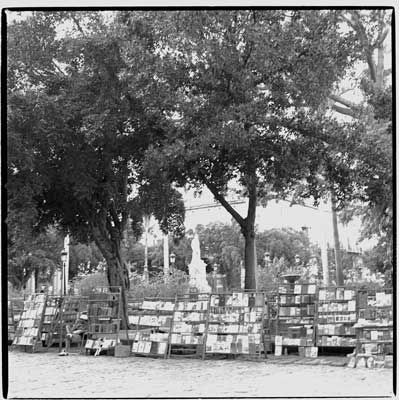 A school in Miami has taken a book about Cuba from its library at the request of several parents. Apparently the book paints a to favorable picture of a child's life in Cuba and this is against the perception of what Castro has visited upon those people and their island home. No matter how one spins this it is censorship, and it is political censorship, and it is a really dumb thing to do. If one is trying to describe how thought and freedom are suppressed, you hardly help your cause by suppressing a book that doesn't fit your preconvceived notions. One of the first small steps toward fascism is trying to control the flow of information and ideas to the people. It is important to let people, including children, find the truth by themselves. Certainly parents and teachers must help, but practicing censorship is just an object lesson in totalitarianism, The photo above is not a good photo, but it does show the book stalls in Plaza Armas. The book sellers are there several days a week. Most of the books are communist era political treatises and /or history books that recount previous communist glories. Occasionally one finds a book by Marti, a book of poems by N. Guillen, an old Hemingway novel or something like that. These books show the vestiges of control that existed and to some extent still exists in Cuba. Unfortunately, the same thing is sprouting like Kudzu in the United States.
Tuesday, June 20, 2006
Playing in the Band
 In this bar on Obispo Street, Lluvia del Oro, or something like that, I encountered this local band. They were all serious music students at the University, several were music teachers on the side, and they really enjoyed playing together. As almost all of these sorts of places open up to the street, the music spills out into the streets at all hours of the day and night, and lends a festive atmsophere. It is always interesting to take a walk in a city in the afternoon and hear someone practicing their music. It seems that the music, unstructured as it might be, wafts freely into the street as a benefit of just being there. More than once , especially in Havana, I have stopped and sat on a wall, the curb, on in an open air café just to listen to someone play and practice their horn or clarinet. The mystery of not knowing exactly who it is and from where it comes, makes it even more fun to do this.
Saturday, June 17, 2006
Proud Father
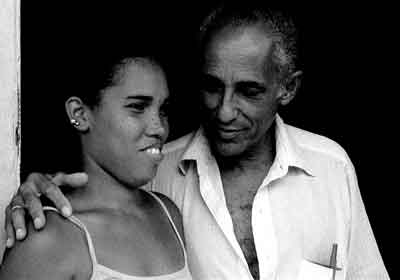 This man was really proud of his daughter. They had a small business doing a little bit of photography for the neighborhood folks. Both were interested in my camera and wanted to show me some of their work. They seemed to enjoy talking photography, even to a stranger. I must confess that I am rarely treated as a "stranger" while in Havana. Most people have questions about the US, about life there, and it seems they all have a cousin or sibling who lives there. On the Father's Day that I was there a festive atmosphere prevailed as I walked about that afternoon. Lots of music, food being prepared, another important day to celebrate--being happy was the order of the day.
Thursday, June 15, 2006
Happy Father's Day
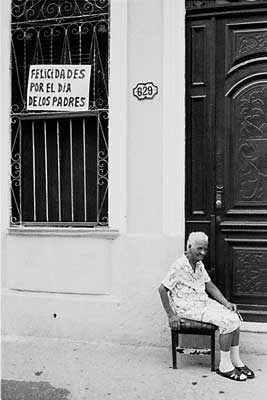 I was in Havana three years ago for Father's Day. The family where I was staying had a party for me and their father. Each of us got a bottle of good rum, a poem, and a song sung by the children. It was a terrific event. I encountered this lady with her sign on the street several blocks away. Holidays and events like we had are a big part of Cuban life. A poem, a special dessert, children singing a song--these are the things that add real soul to life, the Cubans have that in abundance.
Subscribe to:
Posts (Atom)